 For Coloring Pages
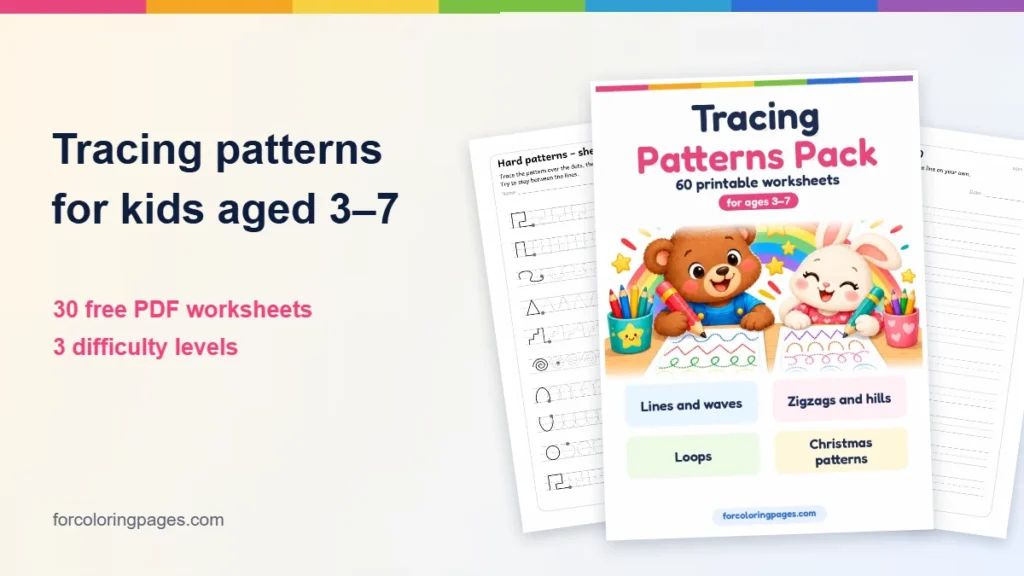
Pre-writing patterns are the simplest way to get a child’s hand ready for writing – before letters come along. All you need is paper, a crayon and a few minutes a day. Below you will find free printable pre-writing patterns in three difficulty levels (for ages 3–7), a guide to which pattern to start with, and the most common mistakes that are easy to fix at home.
Contents
- What pre-writing patterns are and what they give a child
- Printable patterns by age
- In what order to introduce the patterns
- How to practise – 7 tips
- Common mistakes and how to fix them
- A ready set: 60 patterns in one PDF
- Frequently asked questions
What pre-writing patterns are and what they give a child
A pattern is a repeating shape drawn in a line: waves, zigzags, hills, loops, circles or steps. The child traces it along the dots and then tries to draw it on their own. It is a fine motor exercise that develops the precise hand movements needed for writing.
Drawing patterns regularly helps in several areas at once:
- smooth movement – the hand learns to draw without lifting the crayon, just like in joined-up writing,
- left-to-right direction – the same direction we later read and write in,
- staying between the lines – a pattern is drawn between two lines, like a letter in an exercise book,
- hand–eye coordination and focus – the child has to look at the pattern and control the crayon,
- letter shapes – loops are the basis of the letters l and e, while hills and dips lead to m, n and u.
Printable patterns by age
Every sheet is an A4/Letter PDF – you can download it, print it or choose the ink-saving version with lighter lines. At the start of each row the pattern is drawn as a solid line, and a green dot shows where to begin.
| Age | Level | On the sheet | Printable sheets |
|---|---|---|---|
| 3–4 years | easy | 6 big patterns fully on dots: lines, waves, zigzags, hills, circles; a picture to color next to every row | sheet 1, sheet 2, sheet 3 |
| 4–5 years | medium | 8 patterns: on dots, with the end of the line drawn by the child; loops, castles and triangles are added | sheet 1, sheet 2 |
| 5–7 years | hard | 10 narrower patterns, half drawn independently: meander, spirals, steps, lower loops | sheet 1, sheet 2 |
All 30 sheets (10 per level) and the pattern coloring pages with pictures are in the patterns & pre-writing category. The ages are a guide – if a 4-year-old breezes through the easy sheets, move on.
In what order to introduce the patterns
Straight movements are the easiest; the hardest are the ones where the hand changes direction or turns back. A good order looks like this:
- Vertical lines (top to bottom) and diagonal lines.
- Waves – the first smooth movement, with no sharp turns.
- Zigzags and hills – the hand learns to change direction.
- Circles – a closed shape, drawn anticlockwise (like the letter o).
- Upper and lower loops – preparation for the letters l, e, g and y.
- Castles, steps, meander – precise right angles.
- Spirals – the hardest, they need constant control of the movement.
How to practise patterns – 7 tips
- In the air first. Draw the pattern with a finger in the air, on the table or on the child’s back – the movement “gets into the head” before the crayon comes out.
- Short and often. 5–10 minutes a day achieves more than an hour once a week. One sheet is just right.
- A chunky crayon or triangular pencil. It is easier to hold correctly, and the hand gets less tired.
- Sitting at a table. Feet on the floor, paper slightly tilted (to the left for right-handers, to the right for left-handers).
- From the green dot, left to right. Watch the direction – it matters more than a perfect shape.
- Praise rhythm, not perfection. Even spacing and a smooth movement are the goal; small slips over the line don’t matter.
- Combine with coloring. The easy sheets have pictures next to the patterns – coloring inside an outline is more hand practice.
Common mistakes and how to fix them
| What you see | What to do |
|---|---|
| The child presses the crayon very hard and the paper crumples | Games that relax the hand: drawing with a finger in sand, painting with a big brush, “writing” on a chalkboard. |
| Draws from right to left | Mark the start with a green dot and the end of the line with a sticker – “we’re driving to the finish line”. |
| Lifts the crayon at every element | Go back to waves and hills; say “up–down–up–down” together in time with the movement. |
| The pattern “runs away” outside the lines | Pick an easier level with taller lines, or go over the lines with a marker. |
| Gets discouraged quickly | Shorten the exercise to 2–3 rows and finish with something the child does well. |
If difficulties persist despite regular practice (hand pain, avoiding drawing, a very unusual grip), it is worth talking to a teacher or an occupational therapist. You will find more pre-writing exercises in printable fine motor worksheets and in our guides to fine motor skills for 4-year-olds and handwriting for 5-year-olds.
A ready set: 60 patterns in one PDF
If you’d like everything in one file, we have prepared the Tracing Patterns Pack – 60 sheets ordered from easiest to hardest. Besides the 30 sheets from the site it contains 30 pack-only sheets: 15 Christmas patterns (trees, baubles, presents) and 15 “Pattern Master” sheets for 6–7-year-olds, where the child draws most of the lines alone. The pack is part of Premium – together with the other worksheet packs and an ad-free site, for a one-time payment.
Looking for other tasks? Visit our printable worksheets – including mazes, counting, and letter and number tracing.
Frequently asked questions
At what age can a child draw pre-writing patterns?
Simple patterns (lines, waves) can be introduced around age 3, when the child can hold a crayon and draw lines. Loops and spirals usually come at age 5–6.
How many patterns a day?
One sheet – a few minutes up to a quarter of an hour. A little every day is better than rarely and long; the hand gets tired faster than you think.
Crayon, pencil or marker?
Start with a chunky crayon (e.g. triangular) – it gives some resistance and teaches pressure control. Older children can move on to a pencil to get used to writing. Markers glide too easily and train the hand less.
How are patterns different from fine motor worksheets?
Patterns are one type of fine motor exercise. Fine motor practice also includes tracing, dot-to-dot, mazes and coloring inside outlines.
Can I print the sheets for my preschool group?
Yes – you can print the free sheets for home and educational use, for example in your preschool group or class. You just may not sell them or publish them as your own materials.