 For Coloring Pages
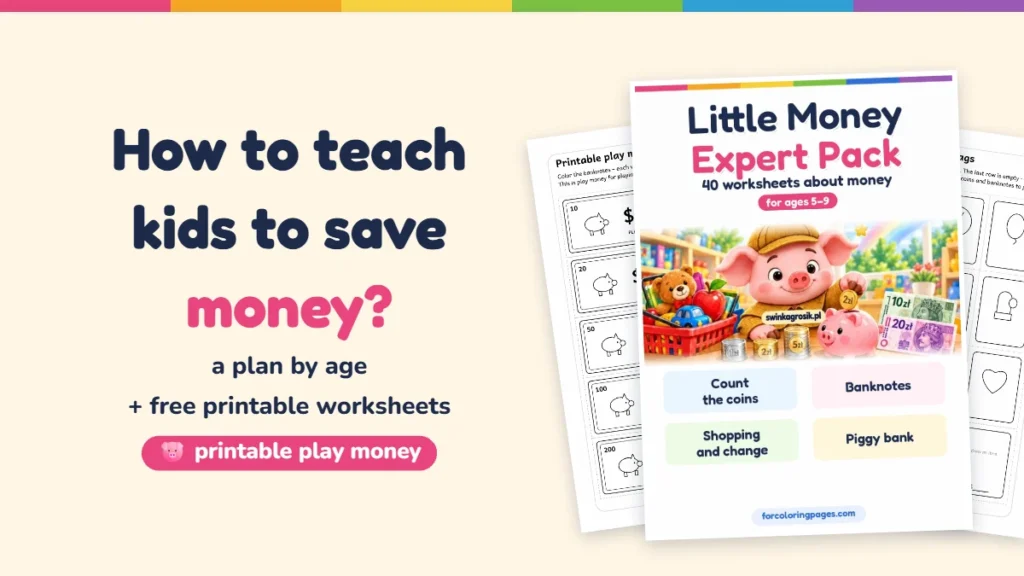
Children learn about money much earlier than they get pocket money: they watch us pay in shops and hear “we can’t afford it” and “let’s save up for it”. The good news is that you can teach saving even to a preschooler – all you need is a piggy bank, a pretend shop and a few conversations. Below you’ll find a plan by age, pocket money tips, the most common parenting mistakes and free printable worksheets: play money, price tags for playing shop and a savings plan to color.
Contents
- Why teach kids to save
- How to teach kids to save – a plan by age
- Pocket money – when to start and how much
- Printable worksheets: money, a pretend shop and a savings plan
- 5 mistakes that put kids off saving
- Frequently asked questions
Why teach kids to save
Saving isn’t just about money in a piggy bank. A child who saves up for a dream item practises patience (the reward comes later), planning (how much do I need to put aside and how long will it take) and decision-making (should I buy something now or wait for something better). These are skills that go far beyond the checkout.
Financial education for kids works best when it’s concrete: real coins in hand, a real goal and a parent who talks rather than just says no.
How to teach kids to save – a plan by age
| Age | What we teach | What to do in practice |
|---|---|---|
| 3–5 | money is exchanged for things; money isn’t endless | playing shop, naming coins, a see-through piggy bank (you can see it grow), dropping coins in after shopping |
| 5–7 | counting money, saving for a small goal, “need” vs “want” | a first small goal, a savings plan on the fridge, paying at the checkout with a parent |
| 7–10 | pocket money, change, comparing prices, a bigger goal over several weeks | regular pocket money, the rule “spend some, save some”, money word problems, checking prices together |
| 10+ | budgeting, saving in a bank, the cost of a “bargain” | a kids’ bank account, a simple weekly budget, talking about what it costs to run a home |
Preschoolers (3–5): play money
At this stage it’s not about amounts but the idea itself: we get things for money, and once it’s spent, it’s gone. Playing shop works best. Print our printable coins and play banknotes, add price tags and let your child take turns buying and selling. Coloring and cutting out the money is also great hand practice.
Kindergarten and first grade (5–7): the first goal
Choose one inexpensive item together that your child will save up for on their own – something reachable within a few weeks. Write it on the savings plan and color one coin for each unit of money saved. Your child sees their progress, and counting “how much is still missing” is natural math. Add the counting money worksheet – six rows of coins to add up.
Grades 1–3 (7–10): pocket money and change
This is a good time for regular pocket money and the rule “save first, then spend”. A popular system is three jars: spend, save, share (e.g. a present for someone close). Children this age can count change and pay in a shop on their own – start with small purchases and practise at home with the shopping and change worksheets.
Pocket money – when to start and how much
There’s no single right amount – it depends on the family budget and what the pocket money is meant to cover. A few rules that work in most homes:
- Start around age 6–7, when your child can count to 20 and understands that money runs out.
- Regularly, always on the same day – predictability teaches planning.
- Weekly rather than monthly for younger kids – a month is forever for a 7-year-old.
- A simple rule to start with: some parents give one unit of currency per week for each year of age – a starting point, not a rule.
- Agree what the pocket money is for (sweets, stickers, small toys) and what parents still pay for.
- Don’t take pocket money away as punishment – it mixes learning about money with discipline.
Printable worksheets: money, a pretend shop and a savings plan
All worksheets are free PDFs. In the counting tasks, the answers are on the second page, and every sheet can be downloaded in an ink-saving version.
| Worksheet | Age | What it’s for |
|---|---|---|
| Printable money – coins | 4–8 | coins to color and cut out |
| Printable banknotes | 4–8 | clearly marked as play money |
| Playing shop – price tags | 4–8 | 12 items with prices + 4 blank tags |
| Counting money | 5–7 | adding up coins |
| Money problems – shopping and change | 6–8 | how much will I pay and how much is left |
| Savings plan for kids | 5–10 | a goal, an amount and coins to color for every unit saved |
You’ll find all the worksheets in the play money category. If you prefer talking while coloring, try our Piggy Penny coloring pages with ready-made questions for your child.
Want more? Premium includes the Little Money Expert Pack – 40 money worksheets in one PDF: counting coins and banknotes, “where is more money?”, shopping with change, a piggy bank “how much is left to the goal” and more. With answers at the end of the pack.
5 mistakes that put kids off saving
- A goal that’s too far away. For a 6-year-old, saving for half a year makes no sense – the first goal should be reachable within a few weeks.
- “Borrowing” from your child’s piggy bank. Even if you pay it back, your child learns that savings aren’t safe.
- Topping up when they’re short. Sometimes it’s worth letting them wait another week – that’s exactly the lesson.
- Criticizing every purchase. A bad buy with their own money teaches more than ten talks. Just ask: “Would you buy the same thing next time?”
- Theory only. Children learn by handling money: counting, paying, dropping coins into a piggy bank. Playing shop and worksheets are a great start.
Frequently asked questions
At what age should you teach kids to save?
You can take the first steps with a 3–4-year-old: playing shop, naming coins, dropping them into a piggy bank. Saving for a specific goal usually works from age 5–6, when a child can count and understands that a reward is worth waiting for.
Piggy bank or bank account?
Start with a piggy bank – ideally a see-through one, so your child can see the money grow. A kids’ bank account makes sense later, usually around age 10, when they understand money they can’t see.
Can I print play money?
Yes – our coins and printable banknotes are black and white for coloring and marked “play money”. They don’t look like real money, so they’re fine for home, preschool and school.
What if my child spends all their money right away?
Don’t rescue them with extra cash. When they’ve run short a few times for something they really wanted, talk about it calmly and suggest splitting pocket money into “spend” and “save”. A savings plan on the fridge also helps – a visible goal motivates more than reminders.