 For Coloring Pages
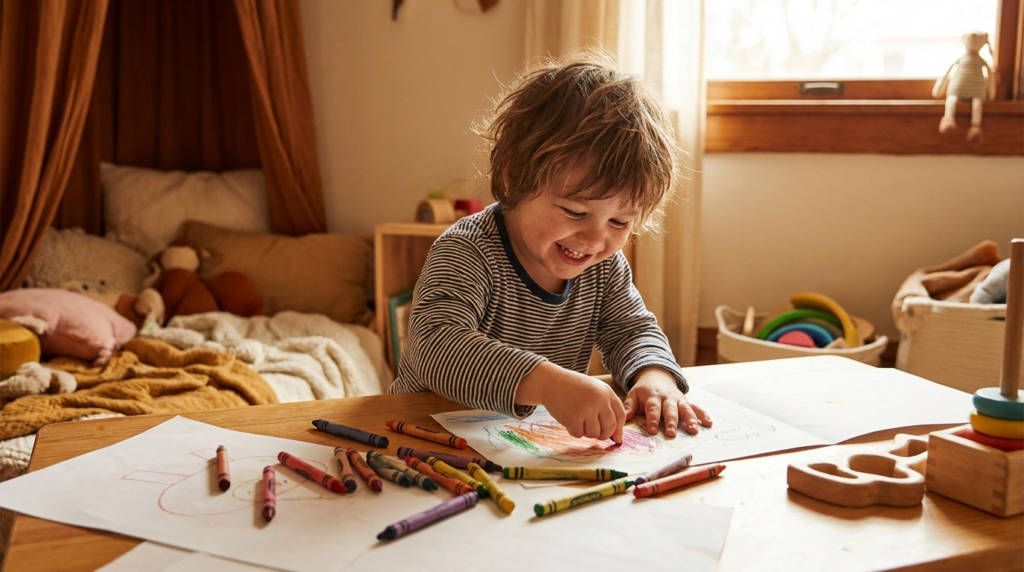
Coloring looks like simple play, but for a child it trains several skills at once: the hand, attention and emotions. Research in early childhood education shows that regular coloring strengthens the hand muscles and prepares the hand for writing. Below we’ve gathered what exactly a crayon develops – and how to use it at home and in preschool.
Key points
- Fine motor skills: coloring trains the crayon grip and hand strength – studies of children aged 4–6 link it to better hand skills before learning to write (Journal of Childhood Development, 2023).
- Attention: finishing a picture takes focus for several minutes or more, which trains perseverance and mindfulness.
- Emotions: coloring designs with a repetitive structure (mandalas) reduces anxiety – as shown in a study in Art Therapy (Van der Vennet and Serice, 2012).
- Getting started: simple, large designs work from age 2–3; the smaller the spaces, the older the child.
Does coloring develop fine motor skills?
Yes. Coloring is one of the first exercises that teaches a child to control the pressure of a crayon and hold it in a tripod grip. Reviews of research on preschool education describe coloring as training for hand-muscle strength that comes before learning to write (Journal of Childhood Development, 2023).
In a typical study design, children aged 4–5 colored in short sessions twice a week for several weeks. The authors noted improved precision of hand movements and better staying inside the lines – exactly the skills school expects at the start of first grade.
From our experience: progress shows fastest when a child colors large areas with clear outlines first and only then moves on to finer designs. A picture that’s too hard discourages them before the hand has time to get stronger.
Simple developmental designs are a good starting point – you’ll find them in our shapes and colors coloring pages and in the educational coloring pages category.
How does coloring affect focus and mindfulness?
Coloring teaches a child to finish a task. Filling in a picture takes anywhere from a few minutes to a quarter of an hour and requires keeping attention on one goal – natural training in perseverance that is hard to achieve with fast, jumping stimuli.
The repetitive, predictable nature of coloring encourages a focused state. The child decides on the colours and the order, so they also practise planning. Does your little one struggle to sit still for one task? A coloring page can be a gentle way to stretch that time by a few minutes.
It’s worth matching the difficulty to the age: the more small spaces, the longer the task and the more focus it needs. Ready-made sets by level are in the educational category.
Does coloring calm children down?
Often, yes – coloring can be a way to wind down. A study published in Art Therapy: Journal of the American Art Therapy Association found that coloring a mandala design reduced anxiety more than free coloring (Van der Vennet and Serice, 2012). The repetitive structure of the pattern has an organising effect.
To be fair: newer research (2024) suggests that the act of coloring itself is soothing regardless of the type of design – not just mandalas. For parents the takeaway is simple: it’s a calm activity that helps release tension after a busy day, before bed or while waiting.
If you’re looking for designs with a repetitive, calming structure, try our geometric pattern and flower mandala coloring pages – regular spaces work well for winding down.
At what age to start, and how to choose a coloring page
Coloring can be introduced around age 2–3, choosing a design that suits the child’s hand. The key is the size of the spaces: a toddler needs big, simple shapes, while an older child can manage finer details.
- 2–3 years: very large spaces, thick outlines, a familiar subject (a simple animal, a shape).
- 4–5 years: medium spaces, more elements, first educational designs (letters, numbers).
- 6+ years: finer details, complex scenes, designs that train precision before writing.
The subject matters for motivation: a child will stick with a topic they love for longer. So alongside developmental designs, keep favourite subjects to hand – for example animal coloring pages, dinosaurs or princesses and fairies. Development and fun don’t have to be opposites.
Frequently asked questions
Does coloring really help with learning to write?
Yes, indirectly. Coloring strengthens the hand muscles and trains the crayon grip – the same ones a child later uses for writing. Studies of preschoolers aged 4–6 link regular coloring to better hand skills before learning letters (Journal of Childhood Development, 2023).
How much time a day should a child spend coloring?
There’s no strict rule. For young children, short sessions of a few minutes work better than one long one. Regularity matters more than time – a few minutes several times a week achieve more than an hour every now and then.
Are educational coloring pages better than ordinary ones?
It depends on the goal. Educational coloring pages (letters, numbers, shapes) combine hand training with learning concepts. Ordinary ones based on favourite subjects are better at building motivation and perseverance. It’s best to have both and alternate them depending on your child’s mood.
Does coloring help children calm down before bed?
For many children, yes. It’s a quiet, repetitive activity that helps them slow down after a day full of stimulation. Research on coloring patterns points to reduced tension (Van der Vennet and Serice, 2012), although the effect is individual – some children do better coloring in the morning.
Summary
Coloring is an inexpensive, accessible way to support a child’s development on three levels at once: hand skills, focus and emotional regulation. The key is matching the design to the age and alternating developmental coloring pages with favourite subjects. You’ll find all the designs you need in our free printable educational coloring pages.
Sources
- Van der Vennet, R., Serice, S. (2012). Can Coloring Mandalas Reduce Anxiety? A Replication Study. Art Therapy: Journal of the American Art Therapy Association. Accessed 2026-07-13, https://eric.ed.gov/?id=EJ988118
- Implementation of Coloring Activities in Early Childhood in Developing Fine Motor Skills. Journal of Childhood Development (2023). Accessed 2026-07-13, https://doi.org/10.25217/jcd.v3i1.3139
- Coloring complex shapes decreases anxiety in three care environments (2024). Frontiers in Psychology. Accessed 2026-07-13, https://www.frontiersin.org/journals/psychology/articles/10.3389/fpsyg.2024.1336202/full