 For Coloring Pages
A child’s memory isn’t a fixed, inborn trait – it’s a skill that can be trained through play. A few minutes a day of simple games really support remembering, attention and learning at school. Below we’ve gathered memory exercises to use at home and in class – simple, cheap and effective.
Contents
- How does a child’s memory work?
- Memory exercises – ready-made games
- How to teach remembering (simple techniques)
- How to weave this into class
- Frequently asked questions
Key points
- Regularity: short daily exercises work better than rare, long ones.
- Associations: children remember more easily when they link something new to a picture or a story.
- Senses: the more senses involved in a game, the stronger the memory trace.
How does a child’s memory work?
Children first remember what they’ve experienced and seen, and only then what they’ve heard. That’s why pictures, movement and emotion fix knowledge more strongly than just repeating words. Memory develops in stages – in preschoolers, incidental memory dominates (they remember things “along the way” while playing), so learning through games is natural and most effective.
Memory exercises – ready-made games
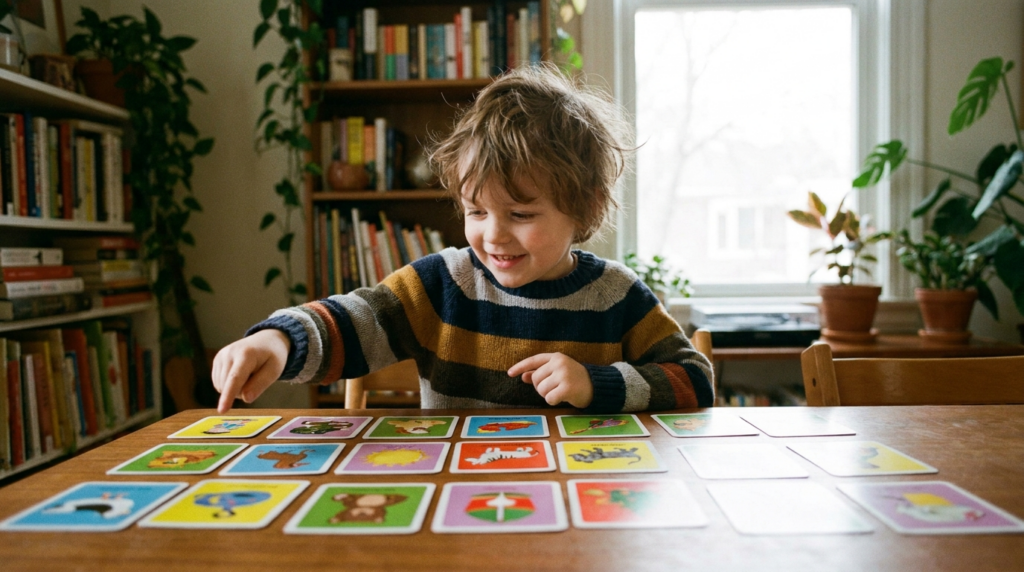
- Picture memory (pairs): turning over cards to find pairs is a classic that trains visual memory and concentration.
- What’s missing?: show a few objects, cover them, take one away – the child guesses what’s gone.
- Word chain: “I went to the shop and bought…” – everyone adds one word, repeating the ones before.
- Movement sequence: show 3 gestures and the child repeats them in order; gradually make the sequence longer.
Cards with repeating pictures are perfect for “what’s missing?” and memory games – you’ll find simple printable pictures in our educational coloring pages.
How to teach remembering (simple techniques)
Teach your child three simple strategies. Association: link a new word to a picture (“S looks like a snake”). Chunking: split longer content into smaller parts. Spaced repetition: come back to the material after an hour, a day and a week – that fixes it most lastingly. The same techniques work for adults, so you’re teaching your child a lifelong skill.
How to weave this into class
Start the lesson with a 3-minute memory warm-up (e.g. “what’s missing?”) – children calm down and focus. Play memory in pairs as teamwork and the word chain as an end-of-day game. Print a set of cards once and use them many times in different variations.
Frequently asked questions
From what age can children train their memory?
From 2–3, as a simple game (picture pairs, “what’s missing?”). As they grow, lengthen the sequences and add words.
How much time a day?
5–10 minutes a day is enough. Short but regular builds lasting results better than long, rare sessions.
Do phone games train memory too?
Physical cards and games with another person involve more senses and a relationship, so for young children they work better than a screen.
Summary
A child’s memory grows through short daily games based on pictures, movement and associations. Memory pairs, “what’s missing?” and the word chain are a ready-made starter set. Download printable cards for these games from our educational coloring pages.
Printable coloring pages – Educational
Below are three free coloring pages from this category. Click a picture to open the coloring page and download it for printing.