 For Coloring Pages
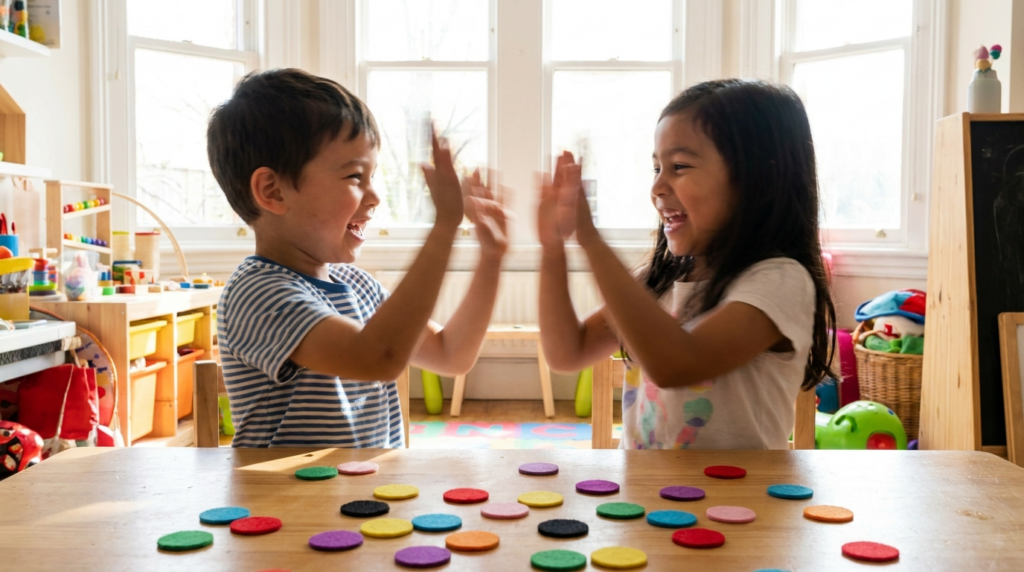
Reflexes – reaction speed – aren’t just for sport: they help a child with writing, reading and focus. The good news: reflexes can be trained with simple games, without equipment and without a screen. Below is a ready-made set of quick-reaction exercises for home and the classroom, with tips on how to make them harder step by step.
Contents
- What are reflexes and why train them?
- Reflex exercises – ready-made games
- How to increase the difficulty
- How to use this in class
- Frequently asked questions
Key points
- Signal–response: you train reflexes by giving a stimulus (a sound, a colour) and getting a quick movement in response.
- No equipment: hands, coloured cards and attention are all you need.
- Short and fun: reflex games are intense – 5 minutes is plenty.
What are reflexes and why train them?
Reaction time is the time between a stimulus and a response – how quickly a child responds with a movement to what they see or hear. By training it you also strengthen attention, body control and inhibition (that is, “don’t do it when there’s no signal”). It’s the same ability that later helps a child focus on a task and not act rashly.
Reflex exercises – ready-made games
- Colour–move: you hold up a coloured card – red means “stop”, green means “clap”. The child reacts as fast as possible.
- Catch the ruler: you drop a ruler or crayon and the child catches it in mid-air.
- Clap on the word: you say words; on the agreed word (e.g. “sun”) the child claps.
- Mirror: you make a gesture and the child copies it immediately – then you change the pace.
For the colour–move game, bold single-colour cards are handy – you’ll find simple templates to print and color in our shapes and colors coloring pages.
How to increase the difficulty
Start with one signal and a slow pace. Once the child gets the rule, add stimuli (two colours, two words) and speed up. The hardest version is “opposite” reactions – red means clap and green means stop. This kind of inhibition training is great for attention in older preschoolers and early school-age children.
How to use this in class
Reflex games work brilliantly as a mid-lesson break – they release energy and gather the group’s attention again. Do them standing, in a circle, for 3–5 minutes. Colour–move and mirror involve the whole class at once and need no preparation beyond a few cards.
Frequently asked questions
From what age can children train reflexes?
Simple versions (mirror, clap on the word) work from age 3. Introduce opposite reactions and a faster pace with 5–7-year-olds.
Does it help with learning, not just sport?
Yes. Reflex exercises strengthen attention and response control, which help children focus, listen to instructions and not act rashly.
How often?
A few times a week for a few minutes. These are intense games, so a short daily dose gives more than long sessions.
Summary
You train a child’s reflexes with a simple signal–response rule: a colour, a sound or a gesture and a quick movement in reply. Start slowly, increase the pace and add stimuli. Download coloured cards for the colour–move game from our educational coloring pages.
Printable coloring pages – Educational
Below are three free coloring pages from this category. Click a picture to open the coloring page and download it for printing.