 For Coloring Pages
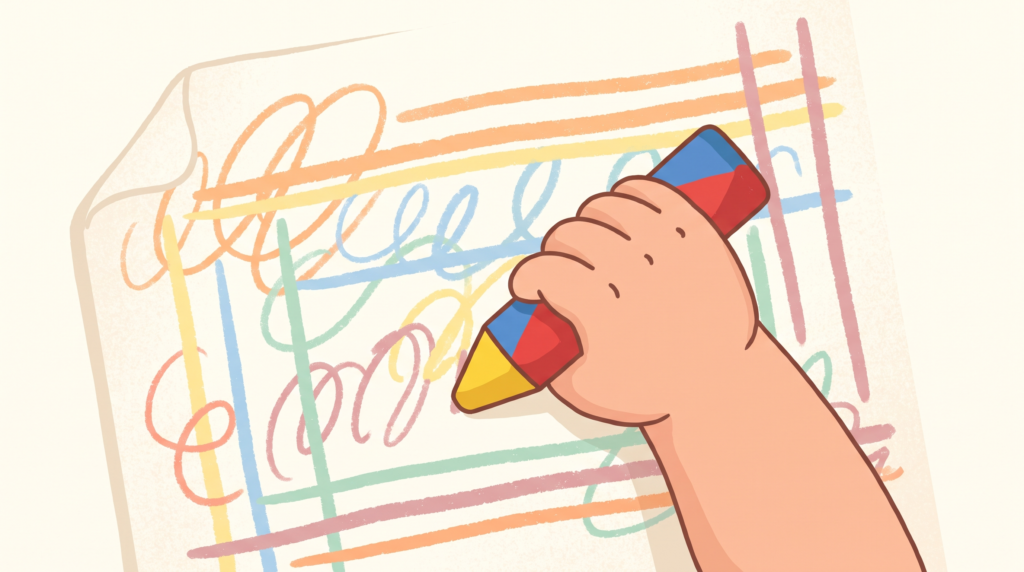
With a three-year-old you don’t practise writing – you practise the hand and the desire to hold a crayon. This is the age when scribbling goes from chaotic to controlled: the child starts deliberately guiding a line and keeping it on the page. Everything happens through play, with big movements and a chunky crayon. Below you’ll find where to start with a 3-year-old, plus free printable fine motor worksheets to get going.
Contents
- What a 3-year-old can do
- Fine motor skills for 3-year-olds – where to start
- Printable worksheets for 3-year-olds
- How to practise through play
- The most common mistakes
- FAQ
What a 3-year-old can do
A three-year-old is only just discovering that a line comes from their own movement. Typical for this age:
- drawing vertical and horizontal lines and controlled scribbles,
- first attempts at a closed circle (often not quite joined up),
- coloring big areas – without staying inside the outline, and that’s OK,
- holding a crayon in different ways – from a fist grip to first attempts with three fingers.
At this stage the gesture itself and the joy of drawing count, not the result. You’ll find the full development path step by step in our guide: printable fine motor worksheets by age.
Fine motor skills for 3-year-olds – where to start
- Big lines. Vertical and horizontal lines, “top to bottom” and “left to right” – on a big sheet.
- Tracks and roads. Thick, short paths to trace with a finger, then with a crayon.
- Coloring big areas. Clear, simple pictures – the goal is filling in, not precision.
- Stamping and dots. Tapping the crayon on set spots trains aiming with the hand.
- Scribbles with meaning. “Draw the rain”, “make the smoke” – the movement gets a meaning and the child is keener to try.
Printable worksheets for 3-year-olds
For a 3-year-old, simple, big designs without small details are best. These work well:
- Thick lines and roads to trace – with a crayon: easy pre-writing patterns.
- Big coloring pages with clear outlines – see our educational coloring pages.
- Simple areas to fill in – plain, with no small elements.
Tip: give a chunky wax crayon and a big format (A4/Letter or larger). A thin pencil and tiny designs are too hard for a 3-year-old’s hand and quickly put them off.
How to practise through play
- Very short – 3–5 minutes. A 3-year-old’s attention is fleeting; stop before they get bored.
- Involve the whole arm. Drawing on a big sheet on the floor or on an easel develops movement from the shoulder.
- Combine with touch. Drawing with a finger in rice, sand or shaving foam prepares for the crayon.
- Strengthen the hand. Squeezing play dough, dropping blocks into a box, tearing paper – it builds hand strength.
- No judging. Every line is good; praise the fact that the child wants to draw.
The most common mistakes
- Expecting them to stay inside the outline. A three-year-old can’t stay within lines – that’s normal, not a reason to correct.
- Designs that are too detailed. Small elements are beyond the hand at this stage; go for big shapes.
- Forcing the grip. The grip matures gradually; offer a chunky crayon rather than positioning fingers by force.
- Sitting at the table for too long. Short and active works better than a forced “exercise”.
- Letters and numbers. Definitely too early – lines and scribbles first.
Frequently asked questions
Should a 3-year-old be drawing already?
Yes, at the level of scribbles and simple lines. It’s the natural start of fine motor development – it’s about movement and willingness, not results.
How long should we practise with a 3-year-old?
3–5 minutes, a few times a week, always through play. Short sessions match attention spans at this stage.
My 3-year-old holds the crayon in a fist – what should I do?
That’s typical for this age. Offer a chunky, short crayon (easier to pick up with three fingers) and strengthen the hand with games. The grip will mature gradually.
Where should we start fine motor practice with a 3-year-old?
With big lines and tracks to trace and coloring big areas with a chunky crayon. Drawing with a finger in rice or sand is a great warm-up before the crayon.
Start with play: download your first printable fine motor worksheets and draw for a few minutes at a time. Once your 3-year-old has mastered lines and circles, move on to the stage for 4-year-olds. All materials are free.