 For Coloring Pages
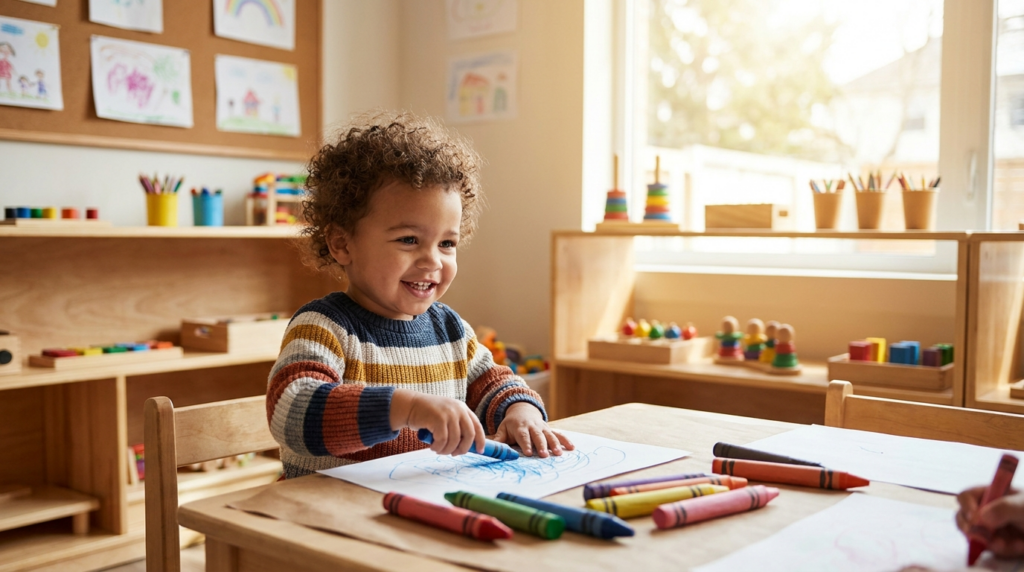
For a 3-year-old, drawing isn’t art but play that trains the hand, the eye and the imagination. At this stage it’s not about a pretty picture but about freedom of movement and the joy of creating. Below: where to start, which exercises work best and how to weave them into activities – for parents and preschool teachers.
Contents
- Where to start teaching a 3-year-old to draw
- Drawing exercises for 3-year-olds
- How long and how often to practise
- How to use this in class
- Frequently asked questions
Key points
- Grip: a fist grip is natural at 3 – chunky crayons make it easier, and the tripod grip will come with time.
- Goal: freedom of movement first (scribbles, lines, circles), not copying.
- Rule: short, frequent sessions of a few minutes work better than one long one.
Where to start teaching a 3-year-old to draw
Start with a big sheet of paper and chunky crayons. A three-year-old can’t hold a thin pencil in a tripod grip yet, so chunky wax crayons are ideal – they don’t need precision and leave a clear mark. Sit next to your child and draw together: show a line, a circle, a sun – but don’t correct their attempts.
The most important thing at the start is that the child wants to pick up the crayon again. Praise effort, not results. First scribbles are a proper, necessary stage – shapes and letters grow out of them later.
Drawing exercises for 3-year-olds
Simple games in which the hand movement has a purpose work well. Here’s a set you can use straight away:
- Lines with a story: “draw a road for the car” – the child guides the crayon from one edge to the other.
- Circles and suns: sweeping circular movements train a smooth wrist.
- Dots and rain: tapping with the crayon develops pressure control.
- Tracing: ready-made designs with dotted outlines guide the hand.
You’ll find ready-made tracing designs and simple outlines to color in our printable pre-writing patterns and educational coloring pages – perfect as first hand exercises.
How long and how often to practise
A three-year-old’s attention is short, so 5–10-minute sessions a few times a week are better than one long one. Stop before your child gets bored – they should be left feeling “that was fun”. Regularity builds the habit and hand skills faster than the length of a single session.
How to use this in class
In a group, working on big formats with a shared rhythm works well: the teacher shows the movement, the children repeat it in the air, then on paper. Set up a few stations (lines, circles, tracing) so children change activity every few minutes. Print several sheets per child – ready-made printables save preparation time.
Frequently asked questions
Should a 3-year-old be drawing recognisable shapes?
Not necessarily. At this stage scribbles and first circles are the norm. Recognisable shapes and figures usually appear later, around age 4.
How should they hold the crayon – should I correct the grip?
Gently show the tripod grip, but don’t force it. Chunky and triangular crayons naturally position the fingers. A correct grip matures gradually up to age 5–6.
My child doesn’t want to draw – what should I do?
Don’t push. Suggest drawing on a big surface, with chalk on the pavement or with a finger in sand. Movement play usually brings back the wish to pick up a crayon.
Summary
Start teaching a 3-year-old to draw with chunky crayons, a big sheet and short, frequent sessions. Focus on freedom of movement and praise effort, not results. Download ready-made tracing designs and simple outlines for first exercises from our educational coloring pages.