 For Coloring Pages
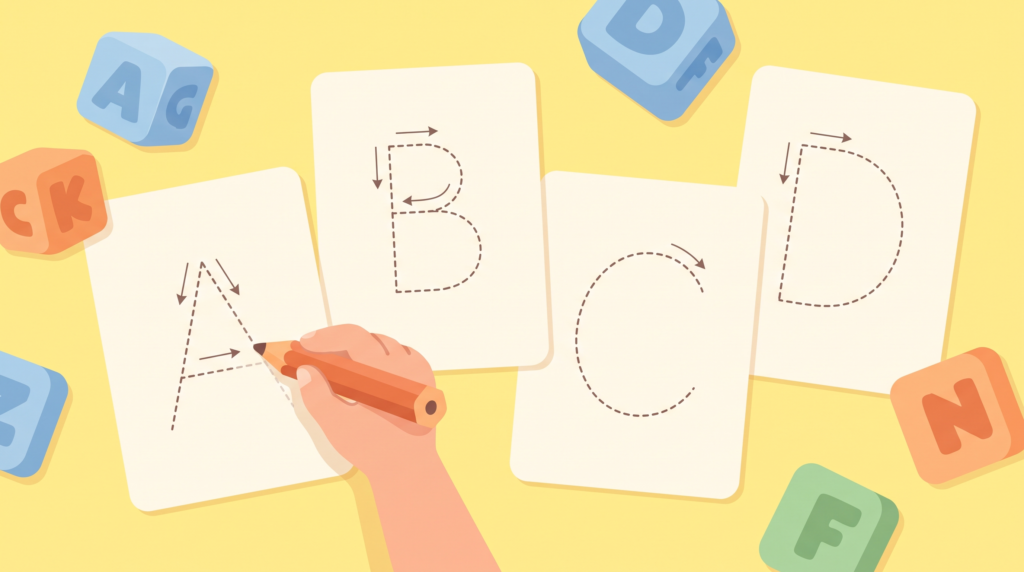
Learning letters at age 5 isn’t about the child “writing neatly” – it’s still too early for that. At this stage the goal is different: recognising letters, linking them to sounds and first tracing. If you start with the right letters in the right order, your child will enter kindergarten with a huge head start. Below you’ll find a concrete plan and free printable letter cards.
Contents
- Is a 5-year-old ready to learn letters?
- Learning letters at 5, step by step
- Printable letter cards
- How to practise without putting them off
- The most common mistakes
- FAQ
Is a 5-year-old ready to learn letters?
Most five-year-olds are ready to get to know letters, but not to write independently. That’s normal – the hand and coordination usually mature for fluent writing around age 6–7. Before a child starts forming letters, they should have the fine motor basics: tracing with a crayon, drawing patterns and controlling pressure.
If your 5-year-old hasn’t practised this yet, start by preparing the hand – we have a ready-made set: printable fine motor worksheets. On that foundation, learning letters goes smoothly and without frustration.
Learning letters at 5, step by step
Order matters. Here’s a proven plan that takes a child from recognising letters to first tracing:
- Start with the letters of their name. Children remember letters that mean something to them fastest. “That’s your letter – M for Mia” works better than the alphabet in order.
- Teach the sound, not the name. Say “mmm”, not “em”. Sounds are what make up words – a child who knows the sounds finds reading easier later.
- Capital letters first. They are simpler (straight lines, fewer curves) than lowercase or joined letters. Leave cursive for later.
- Use all the senses. Before picking up a crayon, let the child “write” the letter with a finger in the air, in rice or sand, or trace a giant letter with a finger. This fixes the shape and direction.
- Trace first, then on their own. Cards with a letter to trace (arrows show the direction) are a natural bridge between recognising and writing.
- 1–2 letters at a time. Don’t introduce the whole alphabet at once. A few letters a week, with review, gives lasting results.
Printable letter cards
The easiest way to learn at home and in preschool is ready-made cards – print, hand over a crayon and practise. In our letter tracing worksheets you’ll find templates to trace and color, and in the educational coloring pages section, cards that pair letters with pictures (A for apple, B for balloon) to make them easier to remember.
- Letter + picture – for recognising the letter and linking it to its sound.
- Letter tracing – for first writing (with direction arrows).
- Letter to color – combines learning with fun and lengthens contact with the shape.
Practical tip: print a card, slip it into a plastic sleeve and give your child a dry-erase marker. They can trace the same letter many times, and you don’t use up paper.
How to practise without putting them off
- Short – 5–10 minutes a day. A five-year-old loses focus and precision when a session drags on.
- Through play. Hunt for the “letter of the day” on signs, packaging and in books. Learning doesn’t have to happen at a table.
- Praise effort. “I can see the letter is following the line” motivates more than “nice/messy”.
- No pressure on pace. One child remembers a letter after a day, another after a week – both are normal.
- A chunky crayon or triangular pencil. They make the correct grip easier and take strain off the hand.
The most common mistakes
- Teaching letter names instead of sounds. “See-ay-tee” won’t blend into “cat” for a child – the sounds will.
- Starting with cursive. Too hard for a 5-year-old’s hand; capitals first.
- Too many letters at once. The whole alphabet in a week = discouragement and nothing sticks.
- Skipping fine motor work. Without hand preparation, letters come out wobbly and the child gets tired.
- Correcting “for” the child. Guiding their hand by force doesn’t teach – show the direction on your own sheet.
Frequently asked questions
Which letters should a 5-year-old learn first?
The letters of the child’s name, then simple capital letters (e.g. O, L, T, I). Leave lowercase and cursive letters until age 6–7.
Should a 5-year-old be able to write letters?
No. At this stage, recognising letters and tracing them is enough. Independent, fluent writing usually develops around age 6–7.
How much time a day should we spend on letters?
5–10 minutes a day, regularly. Short, frequent sessions work better than long, rare ones, because the child doesn’t get tired or discouraged.
Should I teach the letter’s name or its sound?
The sound. Sounds make up words, so a child who links a letter to its sound moves on to reading more easily.
Start today: download and print our letter cards, and prepare the hand for writing with our printable fine motor worksheets. This guide is part of our handwriting for kids series. All materials are free.