 For Coloring Pages
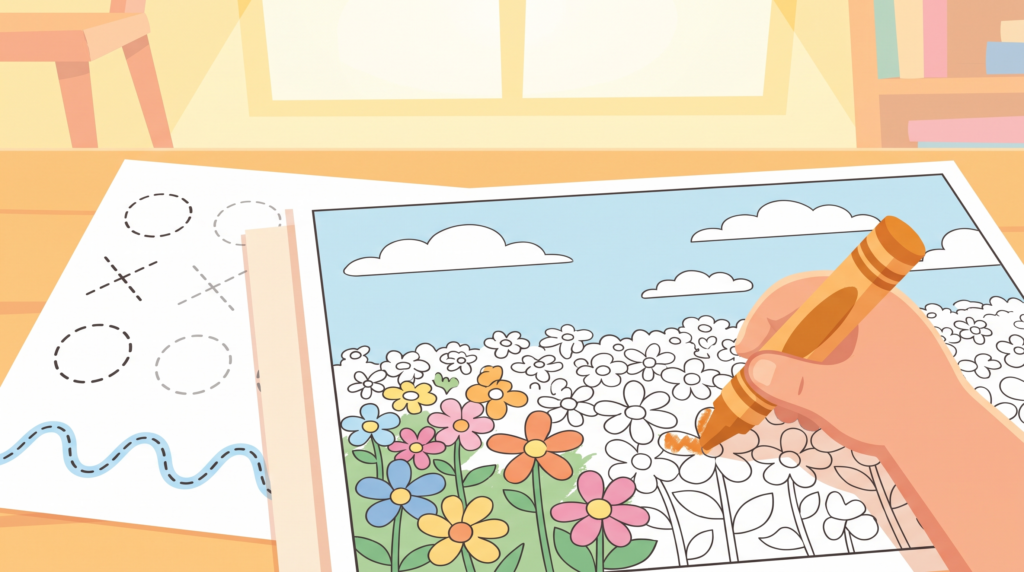
For a four-year-old, fine motor practice isn’t learning to write yet – it’s play that quietly prepares the hand. At this stage a child moves from scribbling to deliberate drawing: they draw circles and simple patterns and learn to color inside outlines. The key is choosing tasks that fit this age and not going too fast. Below you’ll find what to practise with a 4-year-old, plus free printable fine motor worksheets.
Contents
- What a 4-year-old can do
- Fine motor skills for 4-year-olds – what to practise
- Printable worksheets for 4-year-olds
- How to practise through play
- The most common mistakes
- FAQ
What a 4-year-old can do
A four-year-old is moving from chaotic scribbling to controlled movements. Typical for this age:
- drawing a circle and vertical and horizontal lines,
- first crosses and simple, repetitive patterns,
- coloring big areas – still going over the lines, and that’s OK,
- holding a crayon more and more often with three fingers instead of the whole fist.
Don’t expect precision – at this stage the movement itself and the willingness matter. If you want to see what comes before and after this stage, see our guide to printable fine motor worksheets by age.
Fine motor skills for 4-year-olds – what to practise
- Circles and crosses. Basic shapes that letters will later be built from.
- Simple patterns. Dots, lines and big waves – traced along a track.
- Coloring inside outlines. Big, clear pictures; the aim is stopping the hand at the edge.
- Joining dots. Short paths and mazes with wide corridors.
- Tracing. Thick dashed lines for the child to go over.
Printable worksheets for 4-year-olds
Ready-made worksheets make short daily practice easier. For a 4-year-old, these work best:
- Big patterns to trace – circles, waves, simple patterns: pre-writing patterns.
- Coloring pages with clear outlines – see our educational coloring pages.
- A first look at letters as pictures – our letter tracing section (with no pressure to write).
Tip: print the patterns on thicker paper and give your child a chunky wax crayon – a thin pencil is simply too hard for a 4-year-old’s hand.
How to practise through play
- Short – 5 minutes. A 4-year-old’s attention span is short; more often is better than longer.
- No table if needed. Drawing on a big sheet on the floor involves the whole arm.
- Weave in play. “Draw a road for the car” works better than “do a pattern”.
- Strengthen the hand away from paper. Play dough, pouring, threading big beads.
- Praise willingness, not results. At this stage what counts is that the child wants to try.
The most common mistakes
- Demanding precision. Going over the lines at 4 is normal, not a mistake.
- Sheets that are too hard. Tiny patterns and thin lines discourage – stick to big shapes.
- A thin crayon or pencil. It makes the grip harder; start with a chunky crayon.
- Sessions that are too long. A bored 4-year-old can be put off drawing for a long time.
- Jumping to letters. Shapes and patterns first; letters are the age 5–6 stage.
Frequently asked questions
Should a 4-year-old be drawing patterns already?
Yes, but simple and big ones – dots, lines and wide waves along a track. Leave complex patterns until age 5–6.
How long should we practise with a 4-year-old?
About 5 minutes, a few times a week. Short and playful – attention and the hand tire quickly.
My 4-year-old colors over the lines – is that a problem?
No. Precision when coloring inside outlines develops gradually; at 4, going over the lines is completely normal.
What crayon should a 4-year-old use?
A chunky wax crayon or a triangular one – it makes the correct grip easier and suits a hand that isn’t fully skilled yet.
Start with play: download our printable fine motor worksheets and draw for a few minutes at a time. Once your 4-year-old has mastered circles and simple patterns, move on to the more advanced stage. All materials are free.