 For Coloring Pages
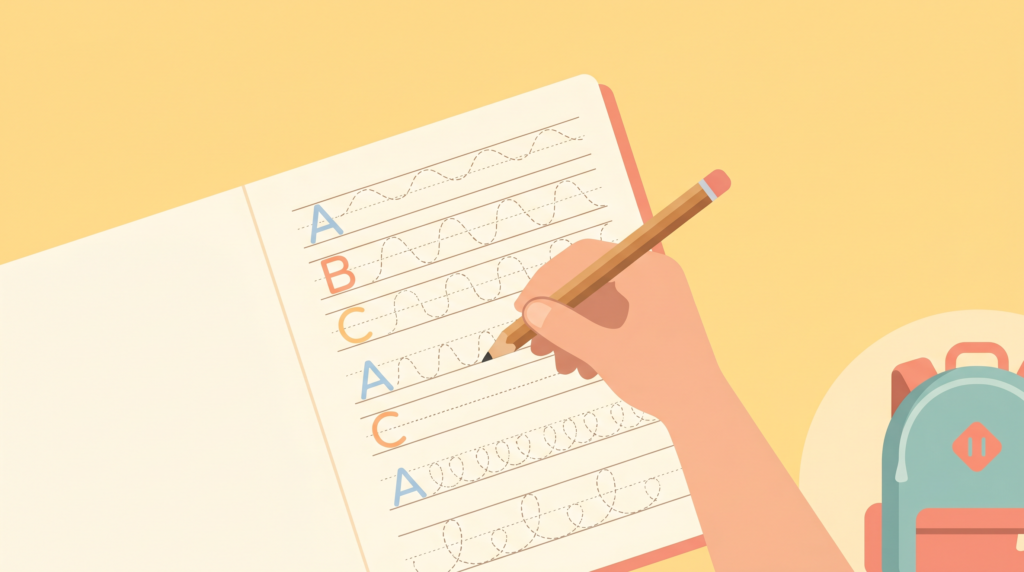
Age six is the year when fine motor practice stops being just play and becomes preparation for writing in first grade. It’s not about calligraphy yet – it’s about a hand skilled enough to keep up with the pace of school without getting discouraged by the first letters. Below you’ll find exactly what to practise with a 6-year-old, plus free printable fine motor worksheets for this stage.
Contents
- What a 6-year-old should be able to do before first grade
- Fine motor skills for 6-year-olds – what to practise
- Printable worksheets for 6-year-olds
- How to prepare the hand for writing
- The most common mistakes
- FAQ
What a 6-year-old should be able to do before first grade
Before a child starts writing letters on lines, their hand should have mastered a few fundamentals. Typical for a 6-year-old:
- A correct grip – tripod (pincer), not a fist grip.
- Tracing – smoothly drawing wavy, looped and zigzag patterns without lifting the hand.
- Copying shapes – a circle, square, triangle and cross from memory or a model.
- Staying within an area – coloring and drawing within set boundaries, first attempts at handwriting lines.
- Pressure control – the line is visible but the paper doesn’t tear.
If any of these are missing, it’s worth going back a stage – a full overview of exercises by age is in our hub: printable fine motor worksheets.
Fine motor skills for 6-year-olds – what to practise
At this stage we focus on precision and flow that will carry over into writing. Priorities:
- Complex patterns. Waves, loops, arcades and pattern combinations – drawn rhythmically from left to right.
- Patterns on lines. Introducing guide lines: the child learns to keep an element between the lines.
- Letter tracing. Capitals, then simple lowercase letters – always with direction arrows.
- Precise shapes. Copying and finishing symmetrical patterns, mazes, dot-to-dot by numbers.
- Pace. Short “beat the timer” tasks so the hand works smoothly, not just accurately.
Learning the letters themselves is best done in parallel – we have a separate guide for that: learning letters (it works as a starting point for 6-year-olds too).
Printable worksheets for 6-year-olds
Ready-made worksheets are the easiest way to practise every day at home and at school. To prepare a 6-year-old’s hand, these are useful:
- Complex patterns to trace – with guide lines: pre-writing patterns.
- Letter tracing – see our letter tracing worksheets.
- Educational sheets – combining a pattern with a picture, in our educational coloring pages.
Tip: print the sheets on 120 gsm paper and slip them into a plastic sleeve with a dry-erase marker – a 6-year-old can repeat the same pattern many times until the movement becomes automatic.
How to prepare the hand for writing
- Regular and short. 10 minutes a day builds the habit better than long sessions now and then.
- Strengthen the hand away from paper. Modelling clay, threading beads, paper tearing – these build the strength needed for writing.
- Watch posture. Feet on the floor, paper slightly tilted, the other hand holding the paper.
- From tracing to independence. Dots and arrows first, then fewer and fewer hints.
- Don’t push calligraphy. The goal is flow and the right direction, not a perfect letter shape.
The most common mistakes
- Focusing on letters and skipping patterns. Without smooth drawing, letters come out wobbly and slow.
- Ignoring the grip. A fist grip that’s set by first grade is hard to change – act now.
- Sheets that are too hard. Materials “for later” discourage; match them to the child’s real level.
- Pressure and rushing. Comparing with peers lowers motivation; children develop at different speeds, and that’s normal.
- No hand strengthening. Worksheets alone, without strength exercises, give slower results.
Frequently asked questions
What fine motor skills should a 6-year-old have?
A correct crayon grip, smooth pattern tracing, copying simple shapes and first letter tracing. Fluent independent writing is still developing.
How much fine motor practice before first grade?
About 10 minutes a day, regularly. Short, frequent practice builds automatic movement more effectively than long, rare sessions.
My 6-year-old doesn’t like drawing – what should I do?
Start with hand-strengthening games (play dough, paper tearing) and short tracing sheets. If the reluctance persists despite trying, it’s worth seeing an occupational therapist.
Capital or lowercase letters first?
Capitals first – they are easier for the hand. Lowercase and cursive come later, once patterns and traced capitals are mastered.
Start today: download our printable fine motor worksheets and practise for 10 minutes a day – the best investment before first grade. All materials are free.